

How Much Money Has Nasa Spent Since 1958
Template:Infobox government agency
As a federal agency, the National Aeronautics and Space Administration (NASA) receives its funding from the annual federal budget passed by the United States Congress. The following charts detail the amount of federal funding allotted to NASA each year over its past fifty-year history (1958–2009) to operate aeronautics research, unmanned and manned space exploration programs.
Annual budget, 1958-2015 [ ]
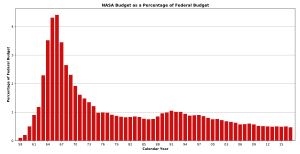
NASA's budget as percentage of federal total, from 1958 to 2012
Seen in the year-by-year breakdown listed below, the total amounts (in nominal dollars) that NASA has been budgeted from 1958 to 2011 amounts to $526.178 billion—an average of $9.928 billion per year. By way of comparison, total spending over this period by the National Science Foundation was roughly one-fifth of NASA's expenditures: $101.5 billion, or $2 billion a year.[1] NASA's FY 2011 budget of $18.4 billion represented about 0.5% of the $3.4 trillion United States federal budget during that year, or about 35% of total spending on academic scientific research in the United States.[2]
According to the Office of Management and Budget and the Air Force Almanac, when measured in real terms (adjusted for inflation), the figure is $790.0 billion, or an average of $15.818 billion per year over its fifty-year history.
|
| ||||||||||||||||||||||||||||||||||||||||||||||||||||||||||||||||||||||||||||||||||||||||||||||||||||||||||||||||||||||||||||||||||||||||||||||||||||||||||||||||||||||||||||||||||||||||||||||||||||||||||||||||||||||||||||||||||||||||||||||||||||||||||||||||||||||||||
Notes for table: Sources for a part of these data: U.S. Office of Management and Budget (OMB) (needs proper citation-link, numbers here differ from NASA Pocket Statistics),
Air Force Association's Air Force Magazine 2007 Space Almanac
Secondary references: [1] [2] [3]Template:Full citation needed
NASA employment [ ]
|
| ||||||||||||||||||||||||||||||||||||||||||||||||||||||||||||||||||||||||||||||||||||||||||||||||||||||||||||||||||||||||||||||||||||||||||||||||||||||||||||||||||||||||||||||||||||||||||||||||||||||||||||||||||||||||||||||||||||||||||||||||||||||||||||||||||||||||||||||||||||||||||||||||||||||||||||||||||||||||||||||||||||||||||||||||||||||||
Reference:
1. Years 1960-1968[12] [13]
2. Years 1969-1978[14]
3. Years 1979-1988[15]
4. CS, Years 1993-1995[16] [17]
5. Year 2012[18]
6. CS, Year 1959-1968, 1989-1996, NASA Pocket Stats: http://history.nasa.gov/pocketstats/sect%20D/CS%20Trend.pdf
7. CS, Year 1993-2011, Workforce Information Cubes: https://wicn.nssc.nasa.gov
8. Contractors, 1969: http://history.nasa.gov/SP-4102/ch5.htm
Cost of Apollo program [ ]
NASA's budget peaked in 1966, during the Apollo program
NASA's budget peaked in 1964-66, when it consumed roughly 4% of federal spending. The agency was building up to the first moon landing; the Apollo program involved more than 34,000 NASA employees and 375,000 employees of industrial and university contractors.[ citation needed ]
In March 1966, NASA officials told Congress that the 1959-72 "run-out cost" of the Apollo program would be an estimated $22.718 billion. The total cost turned out to be between $20 and $25.4 billion in 1969 dollars (about $136 billion in 2007 dollars).[ citation needed ]
The costs of the Apollo spacecraft and Saturn rockets came to about $83 billion in 2005 dollars. Apollo spacecraft cost $28 billion, including the Command/Service Module, $17 billion; Lunar Module, $11 billion; and launch vehicles (Saturn I, Saturn IB, Saturn V cost about $46 billion in 2005 dollars).[ citation needed ]
Economic impact of NASA funding [ ]
The factual accuracy of this article may be compromised due to out-of-date information

A November 1971 study of NASA released by MRIGlobal (formerly Midwest Research Institute) of Kansas City, Missouri ("Technological Progress and Commercialization of Communications Satellites." In: "Economic Impact of Stimulated Technological Activity") concluded that "the $25 billion in 1958 dollars spent on civilian space R & D during the 1958-1969 period has returned $52 billion through 1971 -- and will continue to produce pay offs through 1987, at which time the total pay off will have been $181 billion. The discounted rate of return for this investment will have been 33 percent."
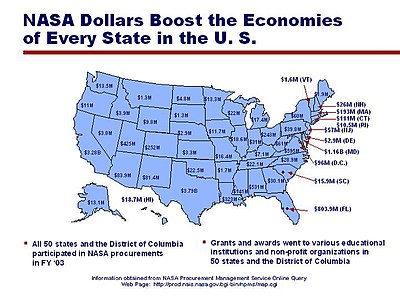
A map from NASA's web site illustrating its economic impact on the U.S. states (as of FY2003)
A 1992 commentary in the British science journal Nature reported:[19]
"The economic benefits of NASA's programs are greater than generally realized. The main beneficiaries (the American public) may not even realize the source of their good fortune. . ."
Other statistics on NASA's economic impact may be found in the 1976 Chase Econometrics Associates, Inc. reports[20] and backed by the 1989 Chapman Research report, which examined 259 non-space applications of NASA technology during an eight-year period (1976–1984) and found more than:
- $21.6 billion in sales and benefits
- 352,000 (mostly skilled) jobs created or saved
- $355 million in federal corporate income taxes
According to the "Nature" commentary, these 259 applications represent ". . .only 1% of an estimated 25,000 to 30,000 Space program spin-offs."
In 2014, the American Helicopter Society criticized NASA and the government for reducing the annual rotorcraft budget from $50 million in 2000 to $23 million in 2013, impacting commercial opportunities.[21]
Public perception [ ]
The perceived national security threat posed by early Soviet leads in spaceflight drove NASA's budget to its peak, both in real inflation-adjusted dollars and in percentage of total federal budget (4.41% in 1966). But the U.S. victory in the Space Race — landing men on the Moon — erased the perceived threat, and NASA was unable to sustain political support for its vision of an even more ambitious Space Transportation System entailing reusable Earth-to-orbit shuttles, a permanent space station, lunar bases, and a manned mission to Mars. Only a scaled-back Space Shuttle was approved, and NASA's funding leveled off at just under 1% in 1976, then declined to 0.75% in 1986. After a brief increase to 1.01% in 1992, it declined to about 0.49% in 2013.
The American public, on average, believes NASA's budget has a much larger share of the federal budget than it actually does. A 1997 poll reported that Americans had an average estimate of 20% for NASA's share of the federal budget, far higher than the actual 0.5% to under 1% that has been maintained throughout the late '90s and first decade of the 2000s.[22] It is estimated that most Americans spent less than $9 on NASA through personal income tax in 2009.[23]
However, there has been a recent movement to communicate discrepancy between perception and reality of NASA's budget as well as lobbying to return the funding back to the 1970-1990 level. The United States Senate Science Committee met in March 2012 where astrophysicist Neil deGrasse Tyson testified that "Right now, NASA's annual budget is half a penny on your tax dollar. For twice that—a penny on a dollar—we can transform the country from a sullen, dispirited nation, weary of economic struggle, to one where it has reclaimed its 20th century birthright to dream of tomorrow."[24] [25] Inspired by Tyson's advocacy and remarks, the Penny4NASA campaign was initiated in 2012 by John Zeller and advocates the doubling of NASA's budget to one percent of the Federal Budget, or one "penny on the dollar."[26]
To help with public perception and to raise awareness regarding the widespread benefits of NASA-funded programs and technologies, NASA instituted the Spinoffs publication. This was a direct offshoot of the Technology Utilization Program Report, a "publication dedicated to informing the scientific community about available NASA technologies, and ongoing requests received for supporting information." according to the NASA Spinoff about page the technologies in these reports created interest in the technology transfer concept, its successes, and its use as a public awareness tool. The reports generated such keen interest by the public that NASA decided to make them into an attractive publication. Thus, the first four-color edition of Spinoff was published in 1976.[27]
[ ]
- 1961— Apollo mission funding PL 87-98 A
- 1970— National Aeronautics and Space Administration Research and Development Act, PL 91-119
- 1984— National Aeronautics and Space Administration Authorization Act, PL 98-361
- 1988— National Aeronautics and Space Administration Authorization Act, PL 100-685
- 2005— National Aeronautics and Space Administration Authorization Act of 2005, PL 109-155[28]
- 2010— National Aeronautics and Space Administration Authorization Act of 2010
- 2014– (proposed) National Aeronautics and Space Administration Authorization Act of 2014 (H.R. 4412; 113th Congress) [29]
See also [ ]
- Space policy of the United States
- Federal budget (United States)
- Budget
- Space exploration
- Vision for Space Exploration
References [ ]
- ↑ "Budget Internet Information System". National Science Foundation. http://dellweb.bfa.nsf.gov/ . Retrieved 2009-01-12.
- ↑ "Federal Spending on Academic Research Continued Downward Trend in 2007". August 25, 2008. http://chronicle.com/news/article/5055/federal-spending-on-academic-research-continued-downward-trend-in-2007 . Retrieved 2009-01-13.
- ↑ 3.0 3.1 % of total federal expenditures from: http://www.guardian.co.uk/news/datablog/2010/feb/01/nasa-budgets-us-spending-space-travel
- ↑ 4.0 4.1 1999-2010 based on federal outlays from: Federal budget (United States)#Total outlays in recent budget submissions
- ↑ 2011 Budget Overview
- ↑ Berger, Brian (2011-04-13). "U.S. Budget Compromise Includes $18.5 Billion for NASA". Space.com. http://www.space.com/11374-nasa-budget-2011-congress-compromise.html . Retrieved 30 January 2012.
- ↑ http://www.nasa.gov/sites/default/files/632697main_NASA_FY13_Budget_Summary-508.pdf
- ↑ http://www.nasa.gov/pdf/750614main_NASA_FY_2014_Budget_Estimates-508.pdf
- ↑ 2015 NASA Budget Estimates
- ↑ 10.0 10.1 10.2 10.3 10.4 2016 NASA Budget Estimates
- ↑ Template:Cite news
- ↑ NASA Historical Databook, 1958-1968, Volume I, NASA Resources, NASA SP-4012v1, 1976, Page 10, http://history.nasa.gov/SP-4012v1.pdf
- ↑ For general discussion on Years 1960-1968, see Chapter 3 of NASA Historical Databook, 1958-1968, Volume I, NASA Resources, NASA SP-4012v1, 1976
- ↑ SP-4012 NASA HISTORICAL DATA BOOK: VOLUME IV, NASA RESOURCES 1969-1978, Table 3-1 (Titled: Civilian and Military In-house Personnel (at end of fiscal year)), Link: http://history.nasa.gov/SP-4012/vol4/t3.1.htm
- ↑ NASA Historical Data Books (SP-4012), Volume VI: NASA Space Applications, Aeronautics and Space Research and Technology, Tracking and Data Acquisition/Support Operations, Commercial Programs, and Resources, 1979-1988, Compiled by Judy A. Rumerman, 1999, Reference: Chapter 7: NASA Personnel, Table 7-1 (Titled: Total NASA Workforce (at end of fiscal year), Page 468 Link: http://history.nasa.gov/SP-4012/vol6/cover6.html
- ↑ http://www.gao.gov/assets/230/223061.pdf
- ↑ http://www.gpo.gov/fdsys/pkg/GAOREPORTS-NSIAD-96-176/html/GAOREPORTS-NSIAD-96-176.htm
- ↑ http://employeeorientation.nasa.gov/contractors/default.htm
- ↑ Template:Cite journal
- ↑ "The Economic Impact of NASA R&D Spending: Preliminary Executive Summary.", April 1975. Also: "Relative Impact of NASA Expenditure on the Economy.", March 18, 1975
- ↑ Hirschberg, Mike. "Investing in Tomorrow's Civil Rotorcraft" American Helicopter Society , July–August 2014. Accessed: 7 October 2014. Archived on 7 October 2014
- ↑ Launius, Roger D.. "Public opinion polls and perceptions of US human spaceflight". Division of Space History, National Air and Space Museum, Smithsonian Institution. http://si.academia.edu/RogerLaunius/Papers/93299/_Public_Opinion_Polls_and_Perceptions_of_US_Human_Spaceflight_.
- ↑ "Personal Income Tax Paid To NASA In 2009 By Income Level". NASACost.com. http://nasacost.com/.
- ↑ "Past, Present, and Future of NASA - U.S. Senate Testimony". Hayden Planetarium. 7 Mar 2012. http://www.haydenplanetarium.org/tyson/read/2012/03/07/past-present-and-future-of-nasa-us-senate-testimony . Retrieved 4 Dec 2012.
- ↑ "Past, Present, and Future of NASA - U.S. Senate Testimony (Video)". Hayden Planetarium. 7 Mar 2012. http://www.haydenplanetarium.org/tyson/watch/2012/03/07/past-present-and-future-of-nasa-us-senate-testimony-video . Retrieved 4 Dec 2012.
- ↑ "Why We Fight - Penny4NASA". Penny4NASA. http://www.penny4nasa.org/why-we-fight/ . Retrieved 30 Nov 2012.
- ↑ "About Spinoff". NASA. No date given. http://spinoff.nasa.gov/spinhist.html . Retrieved 26 Nov 2014.
- ↑ National Aeronautics and Space Administration Authorization Act of 2005, PL 109-155, US Government, December 30, 2005.
- ↑ "H.R. 4412 - Summary". United States Congress. http://beta.congress.gov/bill/113th-congress/house-bill/4412 . Retrieved 9 June 2014.
- Inflation Index
- Budget of the United States Government, Fiscal Year 2009
- Budget of the United States Government, Fiscal Year 2008
- The National Debt in FY 2007 - $406 Billion spent on interest payments compared to NASA at $16 Billion, Education at $61 Billion, and Department of Transportation at $56 Billion.
- Medicare, Medicaid, State Children's Health Insurance Program information
- U.S. Census Clock
- American Association for the Advancement of Science (Research and Development programs budget extract)
- "NASA chief set to cut projects" Orlando Sentinel - Apr. 6, 2007
- "NASA budget $550M less than hoped" Florida Today - Feb. 15, 2007
- "NASA, other agencies denied pay raise" MSNBC and Space.com - Feb. 15, 2007
- "JPL faces program cuts with fewer NASA funds" Pasadena Star News - Feb. 7, 2007
- "NASA Spending Plan Reflects White House Policy" Space News/Space.com - Feb. 5, 2007
- "Highlights of NASA's FY 2008 Budget Request" Remarks by NASA Administrator Michael D. Griffin's during Feb. 5, 2007 press conference at NASA Headquarters
- "NASA's FY 2008 Budget Full Report (4.2Mb PDF) - Feb. 5, 2007
- "NASA's FY 2008 Budget" Budget Summary (710Kb PDF) - Feb. 5, 2007
- "NASA FY 2008 Budget" Presentation Chart (743 Kb PDF) - Feb. 5, 2007
- "Congress may trim NASA budget" Florida Today - Feb. 4, 2007
- "Should NASA be a spending priority?" The Position Page: The Blog of the Orlando Sentinel Editorial Board - Feb. 2, 2007
- "Coalition for Space Exploration Statement Regarding U.S. House of Representatives Budget Proposal" SpaceRef.com - Feb. 1, 2007
- "NASA faces budget cutbacks" Florida Today - Feb. 1, 2007
- "House budget proposal could delay shuttle replacement" Space News/Space.com - Jan. 31, 2007
- "NASA announces FY 08 budget press conference" NASA Media Advisory #M07-014 - Jan. 30, 2007
- "Planetary Society petitions President to save space science" SpaceRef.com - Jan. 22, 2007
- "IFPTE Calls for Balanced and Transparent NASA Budget Preserving Science & Aero, Core Technical Capabilities Achievable Within FY06 baseline" SpaceRef.com - Jan. 2, 2007
- NASA's portion of the Budget of the United States Government, FY 2007 Office of Management and Budget (through the U.S. Government Printing Office)
- NASA 2006 Strategic Plan
- NASA 2006 Pocket Statistics
- NASA FY2006 Budget breakdown
- NASA FY2006 Performance and Accountability Report
- H.R. 3070 - National Aeronautics and Space Administration Authorization Act of 2005 (from Congressional Budget Office, July 20, 2005 - Cost estimate for the bill as reported by the House Committee on Science on July 18, 2005)
- NASA Previous Years (FY2005, FY2004 and FY2003) Performance and Accountability Reports
- NASA FY2003 and Previous Years' Budget
- NASA Strategy based on long-term affordability Budget Chart - Jan. 14, 2004
- Midwest Research Institute homepage
External links [ ]
- Table 1 -- NASA's budget compared to other federal government expenditures (1999 Data)
- Table 2 -- NASA's budget compared to various consumer expenditures (1997 Data)
- Table 3 -- NASA's budget compared to the budgets of the 50 state governments (1997 Data)
- Table 4 -- NASA's budget compared to revenues of various large corporations (1998 Data)
- NASA - Budget Documents, Strategic Plans and Performance Reports (NASA - Budget Information)
NASA | |||||||||
|---|---|---|---|---|---|---|---|---|---|
| Policy and history |
| | |||||||
| Robotic programs |
| ||||||||
| Human spaceflight programs |
| ||||||||
| Individual featured missions (human and robotic) |
| ||||||||
| Communications and Navigation |
| ||||||||
| NASA lists |
| ||||||||
 Commons Commons | |||||||||

How Much Money Has Nasa Spent Since 1958
Source: https://nasa.fandom.com/wiki/Budget_of_NASA#:~:text=NASA's%20budget%20as%20percentage%20of,of%20%249.928%20billion%20per%20year.
Posted by: crandalllauted2001.blogspot.com
0 Response to "How Much Money Has Nasa Spent Since 1958"
Post a Comment